
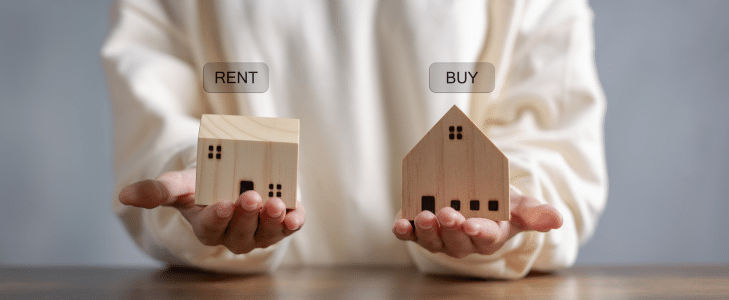
Renting feels safe until your landlord raises the rent. Buying feels smart until you see the full monthly cost. And since a lot has changed in Mississauga in 2026, this guide breaks down what it means for you, and which path between buying and renting makes sense for you.
Is Mississauga Market Good for Buyers and Renters in 2026?
Yes. But Mississauga market is better for buyers in 2026 than it is for renters. Its real estate prices have dropped 6% to $1,003,000 which means that homes cost less than last year. Listings rose 15% which means there are more homes to choose from. It means sellers compete for you, not the other way around. Mortgage rates fell to 3.64% which means your monthly payments are lower than they were in 2023.
However, whether you are looking for an apartment for sale in Mississauga or renting, costs here are still among the highest anywhere in Canada. And since the gap isn’t closing anytime soon, every month you rent, you pay premium prices and build zero equity.
Real Monthly Cost of Buying vs Renting a House in Mississauga
Renting saves you roughly $1,500 to $2,000 every month in Mississauga right now. But that money buys you nothing permanent. You don’t get any ownership, stability, and also your costs rise without warning. Buying costs more each month, but what you pay also brings you equity to make the home yours. Here’s the detailed difference.
| Aspect | Buying in Mississauga | Renting in Mississauga |
| Base payment | Your mortgage is approximately $4,120/mo. But it goes toward owning the home, not just using it. | Your rent is somewhere between $3,200 to $3,800/mo. It’s cheaper upfront, but this money is gone with no ownership built. |
| Property tax | The government charges somewhere between $870 to $910/mo for owning property. Buyers pay this. Renters don’t. | You pay $0 because your landlord handles this matter. Nobody ever makes it your problem. |
| Insurance | You pay $150 to $250/mo which covers the building itself if something goes wrong. | You pay a cheaper price that is $15 to $30/mo and it covers your belongings inside. |
| Utilities | You pay $150 to $350/mo for electricity, gas, and water. It goes up in winters. | You pay the same cost of $150 to $350/mo. No difference for utilities bill. |
| Repairs | The roof leaks? The furnace dies? That’s on you. You pay somewhere between $830 to $1,250/mo. | You pay $0 because your landlord is legally responsible for fixing structural things. Nothing is on your bill here. |
| Cost increases | Your mortgage rate doesn’t change for 5 years. | Your landlord can raise rent to whatever they want when your lease ends because of no rent cap. |
| Total per month | $5,900 to $6,800/mo | $3,425 to $4,300/mo |
The Hidden Upfront Costs of Buying That Most People Overlook
Most people don’t know that when they buy a $1M home in Mississauga, their costs go far beyond the down payment. Minimum down payment alone is $75,000. Plus it comes with a closing costs of 1.5 to 4%. Ontario Land Tax also adds $16,475 to your bill but first timers can save $4,000 on that. In total, most buyers need anywhere from $90,000 to $240,000 ready in cash to buy a real estate property in Mississauga.
The 10-Year Financial Comparison Between Buying & Renting in Mississauga
Reports show that over 10 years, renting in Mississauga saves roughly from $11,600 to $13,300 compared to buying. But it only happens when you invest the monthly savings consistently, and most people never do. Buying builds equity automatically, and a $1M home appreciating just 2 to 3% yearly adds $20,000 to $30,000 in wealth annually. All profits from selling your home are completely tax free in Canada.
So unless you are extremely disciplined with money, buying almost always builds more wealth over time. Renting only makes sense if you are leaving within 5 years, because you spend so much just to buy and sell a home that you end up losing money if you do not stay long enough.
What Renting a House in Mississauga Offers That Buying Can’t
Deciding to rent a house in Mississauga makes more sense than buying when your life is not yet settled. If your income is still growing or unstable, you cannot even qualify for a $1M home without a household income of at least $180,000 to $200,000. If you think you might move within 2 to 3 years, buying makes no sense because selling a home costs tens of thousands in taxes and fees and you simply will not have built enough equity to cover that.
Renting also protects you from surprise repair bills that homeowners cannot avoid, and a single bad year can easily cost $10,000 to $20,000 in maintenance alone. So if you are new to Mississauga, still figuring out which neighbourhood fits you, or not yet financially rock solid, renting first is genuinely the smarter move.
Key Takeaway
Renting the house makes more sense if:
- You might leave Mississauga within 5 years
- Your household income is below $180,000
- You do not have enough saved for closing costs
- Your job or family situation is still changing
- You are new and still figuring out the right neighbourhood
- You want the freedom to move without losing money
- You have existing debt that needs to be cleared first
Buying makes more sense if:
- You are staying in Mississauga for at least 5 years
- Your income comfortably passes the mortgage stress test
- You have savings for down payment and closing costs ready
- You are using FHSA or HBP to maximize first time buyer benefits
- You want the same home and stable payments for years
- You want your monthly payments to build wealth automatically
Frequently Asked Questions:
Is it cheaper to rent or buy in Mississauga in 2026?
Yes. Renting saves over $1,000 per month versus owning an equivalent home. But buying builds equity, so the better path depends on your timeline.
How much do I need to buy a house in Mississauga in 2026?
You need a minimum of $75,000 down on a $1M home, plus 1.5% to 4% of the purchase price in closing costs on top.
What is the mortgage stress test?
It requires you to qualify at your actual rate plus 2%. On a $1M Mississauga home, expect to need a household income of around $180,000 to $200,000.
What first-time buyer programs exist in Mississauga in 2026?
Several strong ones exist. FHSA saves up to $40,000 per person tax-free, HBP allows a $60,000 RRSP withdrawal, and Ontario offers an LTT rebate, a federal tax credit, and an HST rebate on new builds until March 2027.
Is 2026 a good time to buy in Mississauga?
Yes. It’s better than it has been in years because of recent adjusted prices, high inventory, and lower rates. Working with the best real estate agents in Mississauga such as Realtorsr can help you navigate these conditions and find the right deal faster.
How does Mississauga compare to Toronto for renting vs buying?
Mississauga wins on closing costs since there is no municipal land transfer tax. Those looking to rent a house in Mississauga also get more space and better value than Toronto for the same price.